Showing posts with label RBI. Show all posts

Monday, June 20, 2016

Rexit


Yesterday, June 18, 2016, Raghuram Rajan in an email address to his staff in RBI communicated that he is not going to seek an extension to his term as a RBI governor, which is ending on September 4, 2016 and will be going back to academia. The timing of his decision is debatable considering the upcoming Brexit voting but his decision may not be debatable considering recent mud-slinging on him.

Three years ago when then Prime Minister Manmohan Singh appointed Raghuram Rajan as RBI governor, I wrote about Rajan's challenges of dealing with Impossible Trinity. When he was appointed in 2013, India was facing problems of decade low growth rate, tumbling domestic currency and double digit consumer inflation.

A quick glance at Rajan's term shows us that he quite successfully dealt with all major problems through monetary policy framework. Immediately after taking the charge he helped the domestic banks to tap large chunk of legitimate foreign funds as deposits in India, which minimized the pressure on Rupee and reduced the volatility on a greater extent.

Under his leadership, RBI changed the inflation watch from old fashioned WPI index to more relevant CPI index and built consensus along with the government of getting a mandate of CPI inflation target 5% by March 2017. During three years of his tenure as RBI governor, he quite successfully brought down CPI inflation from about 11% to 5.7% and now on track to achieve the target. After being inflation warrior during his initial tenure, he adopted to monetary accommodative stance in latter part as he achieved the inflation controlling task.

In addition to monetary policy regulation, he managed to intervene before non performing assets of banking sector spread further and burst. Also, Rajan brought in more competition in banking sector by giving new licenses.

Now the big question for Narendra Modi and his government is who is going to fill the big void created due to Rajan's exit (Rexit). How the government will manage to change the perception of manner in which Rexit happened?

Wednesday, November 5, 2014

Effectiveness of Quantitative Easing (QE)

Last week, October 29, 2014, the U.S. Federal Reserve (Fed) concluded its $4 trillion QE programs   saying "there has been a substantial improvement in the outlook for the labor market" and "there is sufficient underlying strength in the broader economy". Many economists’ opinions on QE are divided,  some arguing in favor of it and some against it. Let’s have a look at the things, how they unfolded…

How it all started?
It all started with 2007-2008 financial crisis, to avert the ripple effects of the crisis, Fed started with reducing its fed fund rate and ended up with pumping trillions of dollars of money through three QE programs. After New Century Financial Corporation, a leading subprime mortgage lender, filed for bankruptcy in April 2007, rating agencies became cautious and started downgrading subprime mortgage bonds. Looking at the financial markets’ nervousness and to maintain the liquidity in the system, Fed started with 50 basis points cut in fed fund rate to 4.75% in September 2007 and by April 2008 fed fund rate touched 2%. Within 8 months, Fed reduced its interest rates by 325 basis points.

On September 7, 2008, the Treasury department took control of mortgage giants Fannie Mae and Freddie Mac and pledged a $200 billion cash injection to help the companies cope with mortgage default losses.

World financial markets spooked on September 15, 2008, when Lehman Brothers filed for Chapter 11 bankruptcy protection. As result of Lehman collapse, global money market immediately dried up, equity markets routed like there is no tomorrow, bonds and dollar skyrocketed. After seeing this, U.S. government, Treasury department and Fed took various measures to calm the financial markets.

Immediately after Lehman collapse, Fed and the U.S. government helped the one of the world’s largest insurer, AIG with $85 billion. In other words, AIG was bailed out by Fed and the U.S. government.

Within matter of three months, Fed reduced fed fund rate by more than 175 basis points to keep it between 0 to 25 points in December 2008. In between, when fed fund rate was about reach near zero levels, Fed started realizing the liquidity trap problem in traditional monetary approach. Ben Bernanke at helm of the Fed, who extensively studied Japanese lost decade and 1930s the great depression, started thinking of unconventional ways to pump the money into the economy.

QE1, QE2 and QE3
QE1 began in November 2008, with Fed deciding to buy $500 billion worth of mortgage backed securities (MBS) from financial market participants, $100 billion worth of debt obligation mortgage buying from giants Fannie Mae, Freddie Mac, Ginnie Mae and Federal Home Loan Banks. Fed did extend another $100 billion to Fannie Mae, Freddie Mac and Fed also announced the purchase of another $300 billion worth of long term treasuries. When QE1 ended in first quarter of 2010, Fed almost spent about $100 billion every month on buying mortgage backed securities for 17 months. That means, Fed was sitting up on about $1.7 trillion worth of mortgage backed securities. Overall QE1 can be classified as bailout fund.

In November 2010, Fed restarted its unconventional monetary policy, QE2, with $600 billion worth of long term treasuries buying plan. Fed expected to keep long term treasury rates and interest rates to be lower to speed start the economic activity. As previously announced, Fed concluded its $600 billion bond purchasing program in June 2011. QE2 can be termed as the fund used to kick-start the economic recovery.

In September 2011, Fed came up with yet another program called operation twist, wherein Fed started selling short term treasury bills and notes, and buying long term treasury bonds, to lower the long term treasury yields. Total fund allocated for this program was $400 billion. This showed that Bernanke was shifting the central bank's focus from repairing the damage from the subprime mortgage crisis to supporting lending in general.

In September 2012, Fed announced QE3. It agreed to buy $40 billion in MBS, and continue Operation Twist, adding a total $85 billion of liquidity a month. In December 2012, Fed announced it would buy a total of $85 billion of long-term treasuries and MBS put together. It clarified its direction by promising to keep it until one of two conditions was met: either unemployment rate to fall below 6.5% or inflation rose about 2.0%.

Did QEs Work?
In hindsight it’s always easy to analyze things! But talking about whether Fed’s QEs worked or not, it is somewhat complicated to question to answer and those answers are divided. But many economists agree that Fed accomplished couple of its goals. It’s unimaginable to know what would have happened without Fed's QEs. In the beginning, Fed wanted to stop the financial crisis from getting worse. By buying mortgage securities, Fed prevented more banks from failing and eased the frozen lending and money markets. Also being far more proactive and expansionary in nature of Fed as compared to ECB of European region reflects in the present status of both the regions. Fed helped to stabilize the U.S. economy, providing the funds and the confidence to pull out of the recession.

But whether QEs achieved what they were intended to achieve? Whether they succeeded in creating more jobs, spurring up the economy, boosting the inflation to Fed expectation level? I think answer would be “No”.  
Why QEs didn’t create enough jobs or reduce unemployment rate to Fed’s normal acceptance level of 5%. Why unemployment rate, which rose to 10% in 2009 till today didn’t reduced to before the crisis level of 5%, even after six non-stop years money pumping from Fed. Because monetary policies can't do much to reduce unemployment as liquidity is not the problem. In other words, there is little that expansionary monetary policies can do to increase the job creation.

High unemployment rate is due to two factors: cyclical unemployment and structural unemployment. Cyclical unemployment is caused by the economic downturns and structural unemployment happens when the long-term unemployed people lose their skills, needed to compete in the job market. Even now many economists argue that, present decline in unemployment rate is substantially because of long-term unemployed people quitting the job searching process, which is reducing unemployment rate.

QE didn't achieve Fed's goal of making more credit available and boosting the inflation. It gave the money to banks, which basically sat on the funds instead of lending it out. Though Fed succeeded in lowering the cost for banks to make mortgages, the banks didn’t actually start making more mortgages. Since banks didn't lend out the money, inflation wasn't created in consumer goods. As a result, Fed's measurement of inflation, the CPI, stayed below Fed's target.

However, QE did create an asset bubble kind of situation, first in gold and other commodities, and then in stocks.  An gold price more than doubled, rising from $869.75/ounce in 2008 to $1,895/ounce in 2011. Oil prices more than tripled from around $40/barrel in 2008 to around $120/barrel in 2011. After that, investors shifted to stocks. S&P 500 more than doubled from 700 levels in 2009 to 2000 levels in 2014.

QE could have been better designed. There could have been a better balancing act between monetary and fiscal policies. In retrospect far too much faith was put in the banks to channel the money to where it was needed. Edward Hadas of Reuters Breakingviews once nicely said, QE could have been worse, and it should have been better.

Thursday, October 31, 2013

Rajanomics and its decoding


Prannoy Roy of NDTV discussing overall Indian economic situations like Inflation, Growth (faltering), Sovereign rating and Rupee volatility with RBI governor Raghuram Rajan.  
For Video: Click here

Saturday, September 21, 2013

Interpretations of Raghuram Rajan's monetary policy review

Business Standard: Rajan putting house in order before tapering

Business Standard: Inflation-wary Rajan skips Fed party

The Economic Times: The buck doesn’t stop at the RBI: Lowering food inflation is the govt’s job

The Financial Express: RBI wastes Fed moment

Sajjid Chinoy of JP Morgan: Balanced and pragmatic

Niranjan Rajadhyaksha of mint: Why has Raghuram Rajan hiked the repo rate?

Tamal Bandyopadhyay of mint: Repo hike: A signal of Rajan’s lack of tolerance for inflation

Andy Mukherjee of Reuters BREAKINGVIEWS-Raghuram Rajan wants to be India's Paul Volcker

Indranil Pan of Kotak Mahindra Bank: Rajan responds to the need of the hour

Saurabh Tripathi of The Boston Consulting Group: Raghuram Rajan needs to transform RBI into a multitasking innovator

Siddhartha Roy of Tata Group: Usual prudence takes over

Expert Views in The Economic Times: RBI raises repo rate, CRR on hold

How Raghuram's rate hike is a blessing in disguise

Mayur Shetty of The Economic Times:Is Raghuram Rajan walking ex-Federal Reserve chief Paul Volcker’s talk?


Raghuram Rajan’s first step towards “Walk the talk”

Reserve bank of India governor Raghuram Rajan surprised financial markets on Friday in his first monetary policy review by increasing repo rate. Repo rate is interest rate at which RBI lends to banks.

Financial markets took knock as they weren't prepared for rate hike since economy is growing at slowest pace in recent time, manufacturing/industrial production is almost at standstill and some parts of interest rates were already jacked up to defend the Rupee.

But defying expectations, he decided to,

1) Increase repo rate by 25 basis points from 7.25% to 7.5%
2) Reduce the marginal standing facility (MSF) rate by 75 basis points from 10.25% to 9.5%
3) Reduce the minimum daily maintenance of the cash reserve ratio (CRR) from 99% of the requirement to 95%

On his first day as the Governor of Reserve Bank of India Raghuram Rajan said, “The Governorship of the Central Bank is not meant to win one votes or Facebook “likes”. But I hope to do the right thing, no matter what the criticism, even while looking to learn from the criticism. Some of the actions I take will not be popular.” Guess he was giving signal to markets that he is not here to please, but do the right thing!

By taking these steps he

1) Set his priority of “anchoring inflation and inflation expectations”. He thinks in the absence of an appropriate policy response, WPI inflation will be higher than initially projected and CPI inflation is worrisome. He wants to be ahead of the curve to achieve his target instead chasing it after it goes beyond control. But that doesn't mean he will sacrifice growth to have disinflationary pressure. He believes low and stable inflation in turn boost savings and investor confidence in the economy. He said in concluding remark, “the Reserve Bank will closely and continuously monitor the evolving growth-inflation dynamics with a readiness to act pre-emptively, as necessary”. Here we should remember his first day’s “A central bank should never say “Never”!” remark.

2) & 3) Is reversing some of the steps, which RBI had taken to fight the Rupee depreciation and volatility. These will take care of liquidity pressure in the banking system, additional cost of funding and send out the message loud and clear that normalizing monetary policy operation. Going ahead once the reverse repo-repo-MSF corridor come to normalcy (100 basis points difference between each), repo rate will resume the operational policy rate role.

After watching his media address (following policy review) and listening to teleconference with researchers and analysts, one thing he made sure that he is here for change. Same thing he conveyed on the 4th September, “It involves considerable change, and change is risky. But as India develops, not changing is even riskier.”

Repeatedly he clarified things like Urjit Patel and team working on an inflation model to target instead of either plain WPI or CPI. Unusual but unique, Rajan is trying to do the balancing act between inflation anchoring, easing liquidity measures and bringing back the normal monetary operation procedure.

Now there are pitfalls in his walk. Being election year will finance minister allow him to take his own decisions and if yes how long? Rajan needs to take Chidambaram and Prime Minister Manmohan Singh into confidence. How long will he be able resist the temptation of growth friendly policy than targeting inflation? Will he able to balance between 3 legs of the impossible trinity in worst case? Will he be transparent in communicating policy guidance, without surprising too many times?  


Thursday, August 29, 2013

Rupee is what rupee does!

Exactly, headline is derived from economic definition of money, "money is what money does", which is applicable to Rupee too. As per economic definition, value of Rupee is determined by its purchasing power parity (PPP) compared to international standards. But is this definition holds true in this turmoil markets? I don't think so.

In recent days Rupee depreciation or speed of depreciation has not only become big issue domestically but also international commentators are expressing their opinions. There are various research reports available in markets now on Rupee’s next target. Some brokerage houses are predicting it will touch 70+ against Dollar and some are telling it will go back to 60/Dollar. Now everybody is watching whether Rupee will touch 70 before 60 or 60 before 70.

Most of us by now know the macroeconomic issues India is facing due to which currency is moving in this fashion. But here I am trying figure out how things change in the micro level or ground level.

Till early May of this year currency wasn’t our big news or concern, analysts were thinking about macro issues like current account deficit, fiscal deficit, inflation, RBI’s stance on monetary policy and etc. By this logic nothing substantial happened on macro front, which wasn’t priced in the market at that time.

But in May U.S. Federal Reserve chairman Ben Bernanke first time talked about scaling back the monetary stimulus (Fed is buying $85 billion worth of bonds every month) because of moderate growth in U.S. economy. Immediately after his statement bond markets reacted very sharply and bond yields started spiking. At that time U.S. Benchmark 10 year bond yields where trading roughly around 1.6% and Indian benchmark yields where around 8% as shown in the below two graphs.


Investors were coming to India as there was arbitrage opportunity or interest rate parity due to yield spread between the two countries. Even after incurring currency hedging cost of around 6% foreign investors were making 2% (8% bond yield – 6% currency hedging cost) risk free return.

But once U.S. bond yield crossed that crucial 2% level investors thought investing in U.S. bonds is more profitable than investing in India with less risk. So funds from bond market started flowing out of India and till now roughly $4 billion went out of India according to one estimate.

At the same time U.S. stock markets started regaining their historical highs and were touching new highs due to which money from equity markets also started changing hands. Because of outward movement of money Dollar demand increased and Rupee started depreciating as shown in the third graph. But after initial sell-off in the currency market, sentiments drove the markets with more speed and quantity leading to panicking situation making policy makers nervous! Policy makers did take some half hearted measures and did not convince the markets either through their communication or from their actions leading to rout in the markets!

After this heavy sell-off Finance Minister and some analysts are saying Rupee is undervalued due to overshooting of currency markets. One of the popular indexes to measure the valuation of the currency is Big Mac Index. It gives a rough picture of how a country’s currency is trading in real exchange terms or purchasing power parity. It compares cost of Big Mac of McDonalds in U.S. with other countries.

McDonalds’ Big Mac not sold in India since beef is not common; but it is replaced by Maharaja Mac made up of Chicken. As per latest available data cost of Big Mac in U.S. is $4.56 and Maharaja Mac in India is Rs. 100. So PPP of India is 21.93 (100/4.56). According to Big Mac Index Indian Rupee is undervalued 68% [(21.93 – 67.5)/67.5]. Here I have taken 67.5 as exchange rate of Rupee. Indian currency is the most undervalued currency as per Big Mac Index. 

Friday, August 16, 2013

Do policy makers have any other option?

After recent Federal Reserve meeting, when Chairman Ben Bernanke’s commented about tapering of bond buying program, global financial markets have become very volatile. U.S. benchmark 10 year treasury yields touched 2.8% recently from 1.6% in early May. Hot money started flowing out of emerging markets (EM) following some kind of theme like sell EMs and buy U.S.!

As a result of this majority of emerging countries’ stock and bonds sold-off, currencies started depreciating. Being part of globalized world now, India too is going through all these market phases. Apart from global issues, India has its own problems like large current account deficit, corruption and scandals, policy paralysis making it as non-favorable destination for investment at least for now. Indian growth, measured in terms of GDP, slowed to 5% levels from above 9% levels, Industrial Production data is not showing recovery signs, Consumer Inflation still very high and whole price inflation started inching up again; currency depreciated more than 12% in 12 weeks. 

Indian central bank, RBI is under pressure to support the growth, curtail depreciation of Rupee, monitor the capital flows and has to maintain its independence. RBI is exactly in “impossible trinity”.  

Consequently government and RBI took several measures to curb the currency depreciation and capital flight from India, like hiking gold import duty couple of time, banning importing of bullion coins and medallions, asking gold importers to keep 20% of total imported gold for exports and exports-purpose, domestic liquidity tightening, reducing the limit for Overseas Direct Investment (it’s like Indian FDI abroad) from 400% of the net worth to 100% and so on.

Many commentators are now criticizing these recent policy moves and intervention in market. It’s not the question of either supporting or opposing them, whether policy makers have any other option which will help them in near term? Of course there should not be any second thought on long term plans to correct the fundamentals; but what about immediate future as Keynes famously said “In the long run we are all dead”. 

This brings back the old question, whether markets are efficient or in other terms does efficient market hypothesis holds true? Going by Keynesian concepts and economic boom and bust cycles it does appear like markets need an invisible-hand to guide them and calm the nerves. But that again depends on how big that invisible-hand is, how far it is non-conventional in its approach and how much market is ready to listen to it and trust. Only time will tell!

Wednesday, August 7, 2013

Raghuram Rajan's Trilemma


Yesterday, 6th August, 2013 Prime Minister Manmohan Singh appointed Raghuram Rajan as next Reserve Bank of India's governor for 3 years. Rajan will take the charge from present RBI governor D. Subbaroa whose term is ending on September 4, 2013.

Rajan is taking charge at a crucial stage of economic cycle, where India's growth rate is at decade low, currency is depreciating, CPI denominated inflation is high even though wholesale and its core inflation is under RBI's comfort zone. Its like Rajan will be under the pressure of Trilemma (or also famously known as Impossible Trinity) wherein he has to manage currency, capital flows and independence of monetary policy. In theory it is considered to be impossible to achieve all three at the same time and this is what Raghuram Rajan will be facing!

In recent months capital is flowing out from the emerging countries after U.S. Federal Reserve officials started giving hint of tapering down of monetary stimulus know as Quantitative Easing. These capital outflows aggravated in India as economy was not growing at its potential, has current account deficit problem, government is in back-foot in decision making after series of corruption scams and etc. As a result of this Rupee is leading the depreciation pack in Asia and touching new lows.

To reduce the volatility in foreign exchange as it is claimed by central bank, RBI came into markets in intervals and started selling Dollars. Also took several decisions including liquidity tightening, making gold importing non-conducive and so called Open Market Operation. But it looked like RBI was forced to take certain steps as per its communication with markets and its participants. Which is third leg of Trilemma.

During same time RBI was facing growth concern issues as Indian economy was growing around 5 percent, slowest pace in decade and bottom was not sight! Wholesale inflation was just started reducing from couple of years' double digit mark, so RBI started reducing interest rates.

But thanks to capital outflows and Rupee depreciation, RBI (or forced to) jumped to forex management by tightening liquidity and asking public sector banks to sell dollars on its behalf.

Now RBI caught in between Rupee management, liquidity (or in other term capital flows) control, growth acceleration and getting back the credibility of the independence of monetary authority! Its now Raghuram Rajan trilemma!


Tuesday, October 25, 2011

RBI's 2nd quarter monetary policy highlights

Repo rate increased by 25 basis points from 8.25 to 8.5 per cent.

The likelihood of a rate action in the December mid-quarter review is relatively low.

Based on the current and evolving macroeconomic situation, RBI revised projection of GDP growth for 2011-12 to 7.6 per cent from earlier 8%.

Deregulation of the savings bank deposit interest rate with immediate effect; banks are free to determine their savings bank deposit interest rate, subject to the following two conditions:

--> First, each bank will have to offer a uniform interest rate on savings bank deposits up to 1 lakh, irrespective of the amount in the account within this limit.

--> Second, for savings bank deposits over 1 lakh, a bank may provide differential rates of interest, if it so chooses. However, there should not be any discrimination from customer to customer on interest rates for similar amount of deposit.

For banking penetration RBI proposed to permit domestic scheduled commercial banks to open branches in Tier 2 centres (with population 50,000 to 99,999) without the need to take permission from the Reserve Bank in each case, subject to reporting.

In the area of financial markets, four important initiatives have been announced.

--> First, the Reserve Bank will issue the final guidelines on the cash settled 5-year and 2-year interest rate futures (IRFs), including the final settlement price by end-December 2011.

--> Second, guidelines on credit default swaps (CDS) will be made effective by end-November 2011.

--> Third, guidelines on short sale in government securities will be issued by end-December 2011.

--> Fourth, a Working Group will be constituted to examine and suggest ways for enhancing secondary market liquidity in the G-Sec and interest rate derivatives markets.

For more information, click here

Tuesday, July 26, 2011

RBI's anti-inflationary stance: hikes interest rates by 50 basis points

Click here to for full report.

Highlights of the report are...


Increase the policy repo rate under the liquidity adjustment facility (LAF) by 50 basis points. The repo rate will accordingly move up from 7.5 per cent to 8.0 per cent

Consequently, the reverse repo rate under the LAF, determined with a spread of 100 basis point below the repo rate, automatically adjusts to 7.0 per cent. Similarly, the Marginal Standing Facility (MSF) rate, determined with a spread of 100 bps above the repo rate, stands recalibrated at 9.0 per cent.

Expected Outcomes

The expected outcomes of today’s policy actions are the following:

  • First, the cumulative impact of past actions on demand will be reinforced;

  • second, the credibility of the commitment of monetary policy to controlling inflation, and thereby to keeping medium-term expectations anchored, will be maintained;

  • and, third, the policy actions will reinforce the point that in the absence of complementary policy responses on both demand and supply sides, stronger monetary policy actions are required.


It is important to recognise that in the absence of appropriate actions for addressing supply bottlenecks, especially in food and infrastructure, questions about the ability of the economy to sustain the current growth rate without significant inflationary pressures come to the fore. The economy's ability to grow rapidly for any length of time without provoking inflation is dependent on implementing policies, with corresponding resource allocations, which will allow the supply of various products and services to keep pace with demand.

Our baseline projection for WPI inflation for March 2012, as indicated in the May 3 policy statement, was 6.0 per cent with an upward bias. We have reviewed that projection. Keeping in view the domestic demand-supply balance, global trends in commodity prices and the likely demand scenario, we have revised the baseline projection for WPI inflation for March 2012 upward to 7.0 per cent. Let me reiterate what we said earlier, which is that inflation is expected to remain elevated for a few more months, before moderating towards the later part of the year.

The current trends in money supply (M3) and credit growth remain above the indicative trajectory of the Reserve Bank. Keeping in view the evolving growth-inflation dynamics, the indicative projection of M3 growth for 2011-12 has been revised downwards from 16.0 per cent, as set out in the May 3 Policy Statement, to 15.5 per cent. Non-food bank credit growth projection has also been revised downwards from 19.0 per cent to 18.0 per cent.

Wednesday, May 4, 2011

Good article from Jahangir Aziz about RBI's rate hike

We economists are an arrogant lot. If reality doesn’t match with our theory, we find faults with reality.

And so it has been in India for the last several months. Having decided that if it is food inflation then it must be supply shocks, we spent the last year in collective denial that it was loose fiscal and monetary policy pushing demand beyond the economy’s capacity that was the primary driver of inflation, exacerbated by the supply shocks and not the other way around.

And so both the government and the Reserve Bank of India (RBI) kept assuring us that we should not worry needlessly. If the record harvest didn’t tame inflation, base effects would. RBI did raise rates, in fact eight times, but with none of the urgency or aggression that was warranted. Secure in the same belief, the government went on pumping more fiscal stimulus into the economy.

With every passing month as the data unerringly surprised expectations on the upside and as the authorities kept raising inflation forecasts and exhausting one ad hoc explanation after another, these assurances sounded just a little less convincing and just a little more unreal. Instead, tolerating high inflation for this long only hardened expectations, pushing the economy into a generalized inflation spiral as it inevitably does.

More ominously, core inflation appears poised to accelerate further with inflationary expectations hardening by the month, crude prices remaining elevated and leading indicators such as the purchasing managers’ output price index underscoring that even the past rise in input prices have not been fully passed into manufacturing inflation.

Yet, some are still arguing that monetary tightening could cripple growth. Nothing could be more disingenuous. We know at least since 1972 (Bob Lucas’ paper) that the growth-inflation trade-off exists only when expectations are stable, not when they are rising as now, or falling as in Japan in the 1990s. Empirically, we know at least since the late 1980s (Stan Fisher’s paper) that such trade-offs exist only when inflation is low, not when the quarterly rate of core inflation is over 11%. Instead, at these levels, bringing down inflation is essential to safeguard future growth by sacrificing near-term growth.

It is against this context that the central bank came good in its credit policy today. It shrugged off its institutional inertia of moving in predictable 25 basis points (bps) steps, raising rates 50 bps. One basis point is one-hundredth of a percentage point.

The central bank acknowledged that inflation was now driven by demand factors and inflationary expectations were coming unhinged, and laid to rest the growth-inflation trade-off by making inflation control and safeguarding medium-term growth its primary objectives rather than worrying about near-term growth. These are the clearest signals yet that RBI is not afraid of turning on the heat to curb inflation and that we should expect similar aggressive tightening, which most likely will be needed, in the coming months.

Also important was the introduction of the marginal standing facility, which would allow banks to repurchase at any time 1% of deposits at 100 bps above the repo rate. With this change, the banking regulator has now a much better chance of keeping the overnight call rate within 100 bps of the policy rate—the repo rate, something the central bank has struggled to do in the absence of conducting daily open market operations.

That apart, raising the savings rate hopefully is a harbinger of deregulating interest rates on savings accounts. I am sure that there are many good reasons for continuing with our paternalistic attitude to protect the less sophisticated investors such as pensioners and the poor, but presuming them to be naïve is both untrue and disrespectful.

Tuesday, May 3, 2011

RBI increased interest rates by 50 basis points

Today, RBI increased interest rates by 50 basis points, a 9th consecutive move by Indian central banker to curb the inflation.

Before jumping to the internals of the interest rates, lets look at the important changes in the operating procedure...

* The weighted average overnight call money rate will be the operating target of monetary policy of the Reserve Bank.

* There will henceforth be only one independently varying policy rate, and that will be the repo rate.

* The reverse repo rate will continue to be operative, but it will be pegged at a fixed 100 basis points below the repo rate. Hence, the reverse repo rate will no longer be an independent variable.

* There will be a new Marginal Standing Facility (MSF). Banks can borrow overnight from the MSF up to one per cent of their respective net demand and time liabilities or NDTL. The rate of interest on amounts accessed from this facility will be 100 basis points above the repo rate.


* The revised corridor will have a fixed width of 200 basis points. The repo rate will be in the middle. The reverse repo rate will be 100 basis points below it, and the MSF rate 100 basis points above it.


So according to above changes, RBI made increased the interest rates as follows...

* Repo rate increased by 50 basis points from 6.75% to 7.25%

* Due to pegging, reverse repo also increased to 6.25% from 5.75%


* MSF is fixed to 8.25% again due to pegging


* CRR is unchanged at 6%


* Savings bank deposit interest rate increased from 3.5% to 4.0%

Monday, May 2, 2011

Updates...

Markets...

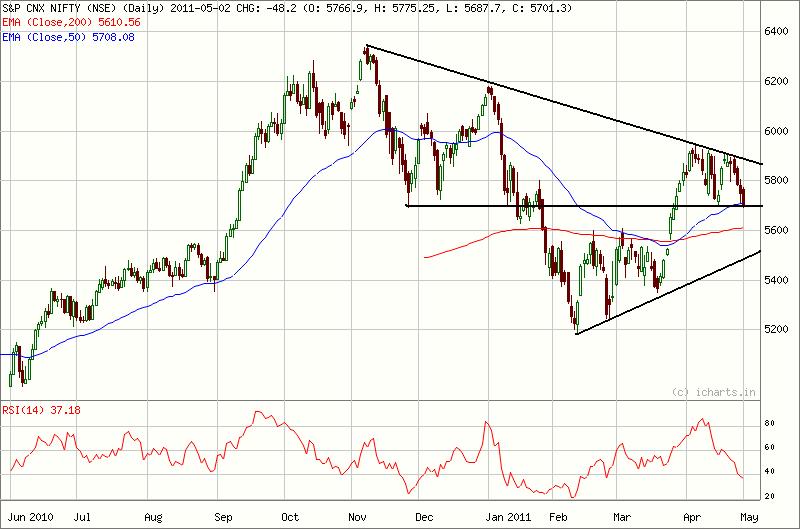
Posting from home, Belgaum, market still looks to be in a symmetrical triangle as tops and bottoms are still tapering out. Nifty has handsome support at 5700, i.e. 50 EMA (Exponential Moving Average) and 5600 i.e. 200 EMA. Maintaining my previous view of break below these above mentioned levels should be short or book profit and break above 5900 i.e. present supply zone, should fresh buying.

RBI...

Today, a day before RBI's meeting on Monetary policy review for 2011, RBI has released Macroeconomic and Monetary Developments in 2010-11, and highlights are as follows...

Growth in 2011-12 is expected to stay close to the trend. Growth risks emanate from high oil prices and some moderation in investment. Business expectations surveys exhibit moderation. Survey of professional forecasters also predicts weaker growth and firmer inflation.

Inflation may remain elevated for some more time despite the current anti-inflationary bias in the monetary stance. Upside risks to inflation arise from high oil and other commodity prices, incomplete pass through and its likely impact on fiscal deficit, elevated inflation expectations and price stickiness.

Global recovery has advanced, but downside risk to global growth arises from oil prices and significant sovereign and banking sector default risks.

GDP growth during 2010-11 reverted to its recent trend, aided by a rebound in agricultural growth. Non-agricultural growth, however, was slightly below trend.

Industrial growth decelerated in the second half on account of high base effect and moderation in investment demand. Manufacturing activity was spread more evenly and the recent slowdown in IIP was exacerbated by volatility in output of a few industries.

Headline inflation exhibited strong persistence in 2010-11 due to supply-side shocks and gradual generalisation of price pressures.

Inflation drivers have changed over three distinct phases. Headline inflation during 2010-11 was impacted primarily by food inflation during April-July, by primary non-food articles during August-November and in a more generalised manner by non-food manufacturing articles since December 2010.

Monday, April 25, 2011

Can hawkish monetary policy alone, control the inflation?

Indian central bank, Reserve Bank of India is meeting on 3rd May for monetary policy meeting of 2011-12 and expected to increase interest rates by 25-50 basis points to rein the inflation. At that time RBI governor Mr. D Subbarao might wonder about the above question as he already increased the interest rates, 8 times in last one year or so. But still many analysts believe, RBI is behind the curve to curb the inflation pressure, as Inflation measured by CPI is in double digits (or near by) through out the year. A year back RBI’s comfort zone of inflation was 5.5% and now it has been revised multiple times and more recently to 8% from 7%. Because of this condition there is a talk going on about Indian economy overheating and India not able to handle the growth!

Economist, Sir John Maynard Keynes and Keynesians believed that “changes in the interest rates do not directly affect the prices and inflation is due to pressure in the economy”. They feel that supply of money is a major, but not the only, cause of inflation. They might be right or wrong in the case of other parts of the world but in Indian case it looks like they are correct. Indian inflation may be due third form of Inflation, i.e. Built inflation and neither Demand-pull inflation (increase in demand) nor Cost-push inflation (drop in supply)! In Built-in inflation, people expect higher prices for future from past experience and also supported by price/wage vicious circle.

The very basic point about inflation is, going by the definition, “its rise in the price levels of goods and services in an economy”. Considering the definition, let’s look at the causes of the inflation in Indian case.

First, inflation can be due to erosion in the buying power of the trading medium, i.e. country’s currency. The best example is recent hyperinflation of Zimbabwe where-in, 1 million Zimbabwean Dollar was equal to 1 American Dollar! But Indian rupee, in last two-three years traded against the major currency, i.e. Dollar in a band of Rs. 44 to Rs. 48 per Dollar. So there is not much scope for this argument.

Second, the Cost-push inflation due to sudden drop in the supply side of the economy. In a globalised world, supply side shocks may not lasts too long, particularly not two years and so (as Indian Inflation is in double digits for almost two years). Take recent example of Onion price, due to shortage, prices doubled and even tripled for a month or so, but once the supply resumed, prices cooled off. The same logic applies to Oil prices also whose price spiked due to Middle East crisis and hopes of recovery. If Oil price spike is only because Middle East crisis and not due to recovery, then it’s very difficult to sustain at this level!

Third, Demand-pull inflation due to rise in the demand because of higher expendable income helped by higher income and supported by higher spending by private and government. According to one school of thought, “Demand inflation is constructive to a faster rate of economic growth since along with favorable market conditions, it will stimulate investments and expansions”. They say, higher growth comes with higher inflation and we need to learn to live with that, if we want higher growth.

The Demand-pull inflation along with Built-in inflation is the most feasible reason for the Indian inflation from above mentioned three types of causes. Digging even further tells us that inflation is a part of the broad economical cycle and very structural in nature. So to curb this kind of inflation, there should be combined efforts from RBI (in monetary front), Governments (in reducing fiscal/current a/c deficit by reducing spending), lesser Borrowed inflation (from across the border in terms of imports), people’s mentality and so on. Finally we must remember nothing is decoupled in an open economy!

Saturday, April 23, 2011

Good articles...

While browsing through Ajay Shah's blog, found couple of articles are good, so thought of sharing with you guys...

Mr. Deepak Lal's article in Business Standard regarding "Capital Controls" is very good reading material on interlinked macro economics. One piece of the article is as following...

"The current account deficit is by definition the difference between a country’s savings and investments, matched as a matter of accounting by equivalent net inflows or outflows on the capital account of the balance of payments. Current account deficit worries are, therefore, about the size of the capital inflows, which, Ceteris Paribus, will supplement domestic investment and raise it above what could be financed by domestic savings. This should raise growth rates, if the investment is productively employed. It clearly was not the case in the US, where the inflows primarily went to finance the politically-determined entitlements in the sub-prime housing market to Ninjas (borrowers with no income, no job and no assets). But, in India, which has vast infrastructure investment needs, capital inflows would be productive and the size of the corresponding current account deficit should not be a matter of concern to policy makers."


Ila Patnaik's article in Indian Express on GDP growth and Inflation. Will be a good reading on presently going on hot topic of Indian Economy Overheating. For more posts on Indian economy overheating, click here: 1, 2 and 3.

Wednesday, April 20, 2011

mint artilce: Why India overheats

Continuing my postings on "Indian economy overheating" articles, today I read an article in mint so thought of sharing with you guys.

Highlights of the article...

There is a structural element in the inflation trend, as higher incomes have raised demand for fruit, meat, vegetables and milk. Some inflation has also been imported, as global oil and commodity prices have shot up thanks to the strong economic recovery in emerging markets and loose monetary policies in most Western economies. But domestic cyclical factors are undoubtedly a big part of the story as well.

High inflation expectations could fuel demands for higher wages as well. Whether these two factors have an effect on final prices depends on the ability of Indian companies to pass on higher costs to consumers.


RBI will have to raise interest rates far more aggressively than it has till now. The government has already announced a fairly ambitious plan to cut the fiscal deficit. Higher interest rates will weigh down on private demand and less red ink in the national budget will keep government demand under control. Both strategies will mean that some economic growth will have to be sacrificed.


Demand management can work only in the short term. Further, it will involve sacrificing some growth. The more sustainable response will have to come from the supply side, through more investments and higher production capacity in farm and factory.


A final point: the Economic Survey released by the finance ministry in February used simple calculations to show that the Indian economy is quite capable of growing at 9% a year. India has an investment rate of around 36% of gross domestic product. India requires four units of capital to produce one extra unit output.


For full article click here.

Tuesday, April 19, 2011

Ajay Shah's interview to CNBC about Inflation

Yesterday, I saw Ajay Shah's, Senior Fellow, NIPFP(National Institute of Public Finance and Policy) interview in CNBC about Inflation. The way he (or NIPFP) is looking at inflation is clearly worrisome and indicates the RBI is lagging in tackling inflation. I have the transcript of that interview here.

Its a good to read material and also the way they analyze the macro fundamentals of an economy.
Link

Tuesday, April 12, 2011

Indian Economy Overheating

Yesterday, 11th April, 2011 IMF came up with a report, stating emerging economies, particularly Brazil, India, China and sub-Saharan African countries are overheating.

On January 23rd, I posted in my blog about the Indian economy overheating due constant inflation from two years or so.

On 26th January mint published an article on similar topic of overheating of Indian economy due to Inflation pressure.

Today, 12th April 2011, mint has a front page article stating "IMF signals overheating of economy"

See the comparison...

Excerpts from yesterday's IMF report...

The global economic recovery is gaining strength, with world growth projected at about 4½ percent in both 2011 and 2012, but unemployment remains high, and risks of overheating are building in emerging market economies, the IMF said in its latest forecast.

“Fears have turned to commodity prices,” said Olivier Blanchard, Chief Economist at the IMF. “Commodity prices have increased more than expected, reflecting a combination of strong demand growth and a number of supply shocks. These increases conjure the specter of 1970s-style stagflation, but they appear unlikely to derail the recovery,” he told a press conference in Washington.

In many emerging market economies, demand is robust and overheating is a growing policy concern. Developing economies, particularly in sub-Saharan Africa, have also resumed fast and sustainable growth. But the IMF said new risks have emerged.

Rising food and commodity prices pose a threat to poor households, adding to social and economic tensions, notably in the Middle East and North Africa.

The challenge for many emerging and some developing economies is to ensure that present boom-like conditions do not develop into overheating over the coming year. Inflation pressure is likely to build further as growing production comes up against capacity constraints, with large food and energy price increases raising pressure for higher wages.

For full statement click here.

Excerpts from Today's mint headlines...

The International Monetary Fund (IMF) cautioned on Monday that emerging markets such as India are exhibiting signs of overheating, which if not immediately addressed could result in a sharp reversal in the growth momentum.

Overheating of the economy happens when the productive capacity is not able to keep pace with aggregate demand. IMF is, therefore, regardless of the impact on economic growth, making a case for steeper rate hikes by central banks to contain demand and thereby curb inflationary pressures.


HDFC Bank chief economist Abheek Barua said there are “severe signs of overheating” in the economy. “We need to move to permanent slower growth for some time,” he said.


“Signs of overheating are starting to materialize in a number of economies. Continued high growth has meant that some economies in the region are now operating at or above potential. Credit growth is accelerating in some economies (Hong Kong, India, Indonesia), and it remains high in China,” IMF said.


For full mint article, click here.

Excerpts from my 23rd January post...

Many people might be wondering why I am talking about overheating of an economy in the midst of recovery from present financial crisis. Particularly many people may not agree with the Indian Economy overheating concept that too when November IIP numbers are below 3% (2.7% to be exact), Stock market corrected almost 10% in last two months compared to its peers which gained 5%-10% at the same time and etc..

But if you see the inflation number what India is facing from last two years is above RBI's comfort zone of 5% to 6%. For the year 2009 Indian Consumer Price Index was of 8.3% averaged and where as 2010 CPI was 10.9%. Where as from 2003 to 2008 Indian consumer price index moved between 3% to 6% on average basis. So in these last two years Indian inflation went up by 4% points in the consumer price index level. In this inflation CPI or WPI, food inflation has been major contributor towards the both indexes.

I feel India is facing wage inflation, it is condition where in higher wages or increased wages chase little goods available in the market and causing increase in the prices of the goods and in turn putting pressure on wages to hike. Its like a spiraling or vicious circle.


For full blog post, click here.

Excerpts from 26th January mint article...

With high-inflation expectations and an unceasing march of prices, India is close to a wage-price spiral.

Since the new year began, the Indian stock market has fallen 8% below its December peak of 20,509 points. Long bond yields have risen by more than 20 basis points, touching 8.2%. Foreign investors have reduced their weights on Indian investments and capital inflows have turned into a trickle.

There are other reasons, too, for further monetary action. While 36% (3.1 percentage points) of the 8.4% year-on-year rise in the Wholesale Price Index (WPI) in December resulted from food prices, manufacturing inflation accounted for 34% (2.9 percentage points). The persistence in food price inflation, however—a 13.5% increase over December 2009—is now prompting doubters to suspect that strong demand factors could be at play.


Unsurprisingly, inflation expectations look set to be entrenched at higher levels, only a step short of triggering a price-wage spiral.


For article, click here.

Tuesday, April 5, 2011

POST-crisis, PRE-recovery dilemma

The great recession 2007-08 is history now and world is in the brink of recovery (different opinions about shape of recovery) with different pace in different places. Now almost all central bankers (both developed and developing countries) are worried about the future course of monetary actions.

Developed countries like US, UK, European Union and Japan have maintained their respective interest rate at very low levels almost equal to zero to avoid the depression. Since economy is now trying to recover from the crisis, these above mentioned country's central bankers are facing their own issues and are in dilemma whether to reverse the monetary stimulus or to go ahead with the present status for some more time?

US is getting mixed data from its economy as it Job data, and inflation data are on the positive side where as housing data is still under the pressure. UK is under the threat of Inflation and Japan is bombarded by Tsunami, nuclear crisis and 2 lost decades. European union is in dilemma as its different constituents are in very widely diverged due to countries like Germany and Ireland (or Greece) are like south and north poles in all aspects of economy.

Coming to developing countries like BRIC (Brazil, Russia, India and China) are clearly under the tremendous inflation pressure. India and China's central bankers increased their respective interest rates almost on an average once in a two month (from more than a year) to control the inflation. Brazil is under the threat of "hot money" flow due to interest rate parity and threating its currency competency. Russians are facing bubble kind of formation in almost all asset class due to rapid increase in their valuation.

Now the big question for all the central bankers is what next?

Yesterday, Tuesday, April 5th 2011 PBOC (People's Bank of China) has increased the lending and deposit rates by 25 basis points to from 6.06% to 6.31% and 3.0% to 3.25% respectively to curb the inflation. According to last available data China's CPI data for the month of February was 4.9% which is almost 1% higher than the PBOC's comfort (target) zone. But the problem PBOC might face in coming days is slower growth as it has forecast a lower GDP for coming years. Remember China spent massive amount (more than 4 trillion yuan) during the crisis times and its banks lent more than double the government spending/stimulus. So the base effect along with reverse the stimulus effect and lesser(than earlier) advantage of currency competence (due to international pressure to yuan pegging) may cause hindrance to Chinese.

Indian central banker, RBI (Reserve Bank of India) has already raised repo rate 8 times (200 basis points) from last one year and still it is indicating the targeting of the inflation. According to latest available data, WPI for February is 8.3% which above 8%, a revised target of RBI (RBI revised its inflation target from 7% to 8%). And RBI hinting to increase the interest rate in first week of May, 2011 when RBI is scheduled to meet. But in the process of inflation target RBI might loose out on GDP growth which has already shown some deceleration in IIP data and also due higher oil imports and high commodity prices cutting the margins of corporate houses and etc.

Tomorrow, April 7th 2011 ECB (European Central Bank) is meeting and many analysts are expecting ECB to increase the interest rates to target the inflation. ECB might be worried about the December inflation of 2.2% which above its target of 2%, but what about Greece, Ireland and other debt ridden Euro zone countries growth! Will it start the process for other developed countries to follow?

MPC (Monetary Policy Committee) of Bank of England is in traction to take the first step to increase the interest rates from 0.5% to 0.75% to target the inflation, but question of the hour is when? According to latest available inflation data for February is increased to 4.4% (from 4%) above the Bank of England's comfort zone of 2%. So will it bite the bullet?

Now there is lot discussion is happening around the FED's possible about QE2 (Quantitative Easing 2), FED rate, Inflation (is 2.1% and FED's target is 2%). FED might be worried about its history of 1936-37 of recession after great depression in 1930. (In the course of 10 months between 1936-1937, FED doubled its interest rates by causing recession!). It also might be wondering about the consequences of premature stimulus exit.

Bottom line:
In almost all the cases of central bankers, everybody is targeting inflation and inflation, mainly increased due to spike in oil prices, high commodity price and higher primary food articles. And inflation in most of the cases is supply side issue also instead of just increase demand! Whether mere increase in interest rates (further more in the case of developing countries) will curb the inflation immediately, without derailing the growth prospects? Global economy may not be ready to face another credit crunch! At the same time, artificial asset boosting by keeping near zero interest rates is also not good for the longer term economy, as fast history is in front us!